
How Does Infrared Heating Work?

The options for greener heating systems are an important topic of discussion in 2024, with all roads pointing to a shift in businesses and consumers lowering their emissions use.
With there never being a better time to consider eco-friendly heating solutions, Tansun research and evidence what infrared heat is, how it works and why it’s different from other forms of heat transfer.
Infrared Heating – How Does It Work [1]
|
How Was Infrared Discovered?
Infrared radiation was discovered in the early 19th century by Sir William Herschel, a British astronomer during experiments with sunlight
[2]. While investigating the distribution of different colours using sunlight via a prism, Herschel observed an increase in temperature which occurred beyond the red end of the spectrum where there was no visible light. The unexpected heat lead to the discovery of infrared radiation, making a pivotal moment in our understanding of the electromagnetic spectrum and its applications – including heating.
Infrared Wavelength
On the electromagnetic spectrum, infrared radiation falls between visible light and microwaves with a longer wavelength than visible light but a shorter wavelength than microwaves. The wavelength of infrared radiation plays a crucial role in its heating capabilities, as it directly influences its ability to penetrate and interact with objects. Understanding this spectrum positioning provides insight into how infrared heating efficiently transfers warmth through radiation.

Caption: The Electromagnetic Spectrum, Showcasing Infrared Wavelength and How Infrared Heating Works
How Does Infrared Heating Work?
Infrared heating operates through the principle of radiant heat which involves the direct transfer of heat from the heater to objects and individuals within a space, bypassing the heater of air in between
[3]. Infrared heating primarily uses radiation as the mode of heat transfer. Objects within the room absorb emitted infrared rays, raising their temperature for some time. This absorbed heat is then released back into the room through three main mechanisms, conduction, convection and radiation.

Caption: Thermal Heat Transfer, Infrared Uses Radiation
| Radiation |
|
| Convection |
|
| Convection |
|
Infrared vs Convection Heater
An infrared heater is essentially a very contemporary take on the commercial and domestic heating landscape, leveraging the principles of infrared radiation to form more targeted, directional heating where and when needed. This operates in a vastly different manner to traditional heating styles which makes use of the convection process to warm up.
Infrared vs Convection Heater Comparison – Industrial
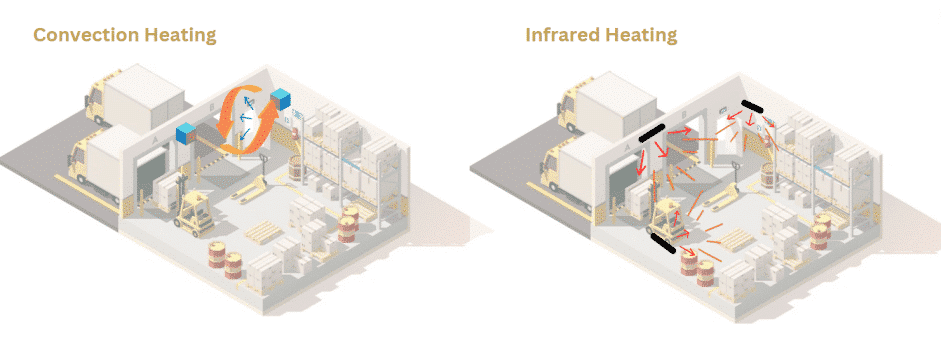
In an industrial commercial setting, the choice between infrared heaters and traditional convection heating systems, like commercial warm-air heaters, hinges on efficiency and effectiveness.
While convection heaters aim to warm a large volume of space uniformly, infrared heaters target specific areas or objects, providing warmth precisely where needed. Research indicates that in scenarios requiring heating for expansive spaces, infrared heaters demonstrate superior energy efficiency, consuming up to half the energy of unit heaters commonly used in such settings
[4].
The warmth generated by infrared heaters is also immediate, contrasting with the gradual warmth provided by convection heaters. Additionally, convection heaters often suffer from heat loss due to poor heat distribution, as warm air tends to rise, leaving lower areas cooler. This disparity underscores the advantages of infrared heating in industrial commercial environments, where efficiency, targeted warmth, and rapid heat delivery are paramount.
Infrared vs Convection Heater Comparison – Domestic and Offices
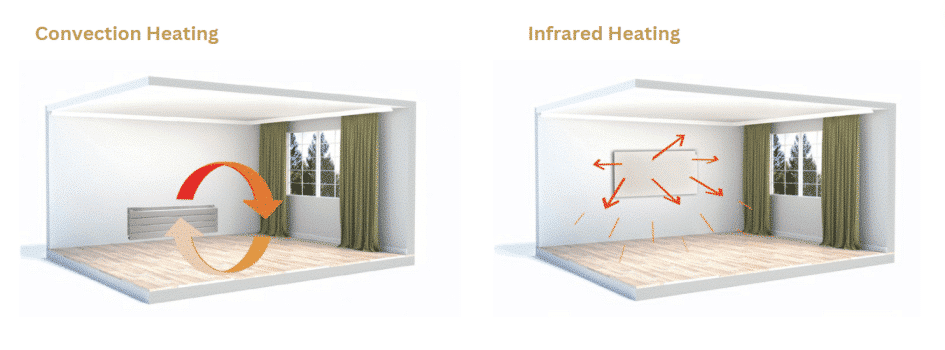
In contemporary settings such as dynamic, agile and flexible workspaces or home environments, radiant panel heaters that utilise infrared offer unparalleled advantages compared to traditional wall-mounted convection heaters.
Radiant panel heaters offer the advantage of zoning, allowing for precise control over heating in specific areas as needed. This level of flexibility aligns well with the dynamic nature of modern workspaces and home environments, where adaptability and agility are crucial. Unlike convection heaters, which aim to uniformly heat large volumes of space, radiant panel heaters provide customisable warmth exactly where it’s required, optimising comfort and energy efficiency. This versatility caters to the evolving needs of modern spaces, ensuring optimal heating solutions for varied and dynamic environments.
Types of Infrared Heating
A more in-depth overview of
different types of infrared heating is available in our detailed analysis here, detailing the various applications, benefits and how some of its drawbacks can be overcome as part of an all-round heating solution in various spaces.
Does Infrared Heating Work?
| Efficiency |
|
| Heat Transfer |
|
| Energy Savings |
|
| Flexibility |
|
| Controllability |
|
The rise of infrared heating signifies a transformative shift in how we approach warmth and comfort. Its unparalleled efficiency, precise controllability, and adaptability to diverse settings herald a new era of heating solutions. As we navigate to a more sustainable future, infrared heating as a cleaner energy-saving alternative becomes increasingly undeniable.
Tansun have compiled this detailed overview to explain how infrared heating works, shedding light on its remarkable potential.
If you have any questions then please get in touch on 0121 580 6200, email sales@tansun.com or follow us on LinkedIn to keep up to date with new case studies, news and technical pieces.
Sources:
[1] Pan, Z. and Atungulu, G.G., 2010. Infrared heating for food and agricultural processing. CRC Press. pp. 57-70. [2] Ring, E.F.J., 2000. The discovery of infrared radiation in 1800. The Imaging Science Journal, 48(1), pp. 1-8. [3] Brown, K.J., Farrelly, R., O’shaughnessy, S.M. and Robinson, A.J., 2016. Energy efficiency of electrical infrared heating elements. Applied Energy, 162, pp. 581-588. [4] Roth, K., Dieckmann, J. and Brodrick, J., 2007. Infrared radiant heaters. Ashrae Journal, 49(6), p.72.HEATERS WE RECOMMEND
-

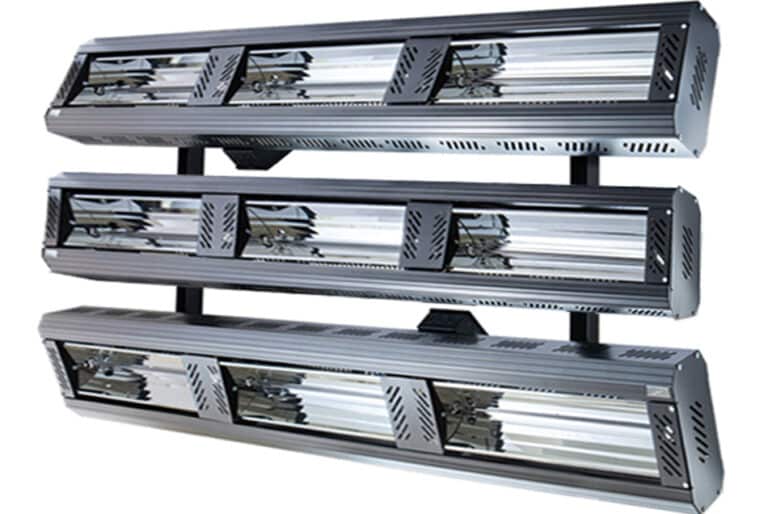
Perfect heating solution for industrial areas and large open spaces.
-

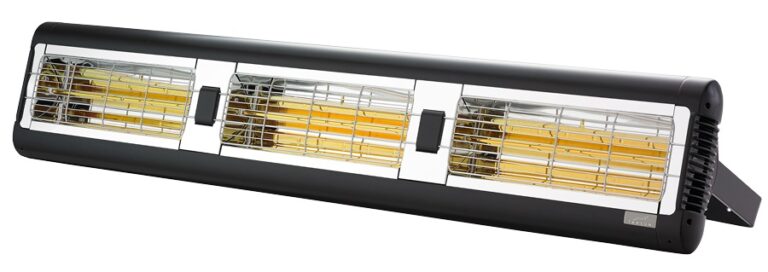
Robust multipurpose weatherproof commercial shortwave infrared heaters.
-

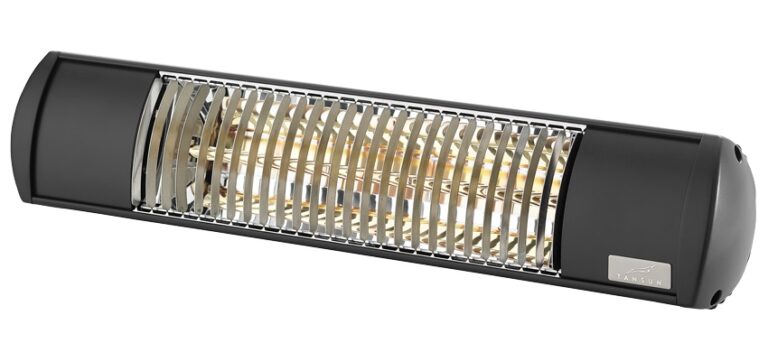
Stylish, elegant weatherproof shortwave infrared heaters perfect for awnings and canopies.
-

Stylish Infrared Heat Panels